EuMAR Registry
The European Monitoring of Medically Assisted Reproduction (EuMAR) is a European registry developed by ESHRE to collect cycle‑by‑cycle data on MAR treatments and outcomes across Europe.
EuMAR started in 2023 as an EU co-funded three-year project to test the building of the registry. A pilot study with four EU countries (Estonia, Germany, Portugal, and Slovenia) ran for six months in 2024 and was validated in 2025.
The successful outcomes of the EuMAR pilot study paved the way to EuMAR 2, a transition two-year period to settle the technical and legal requirements observed during the pilot study and to open participation for other European countries. The overall objective of phase 2 of EuMAR will be to bridge the project stage to a new, permanent data collection at ESHRE.
EuMAR aims to strengthen:
- Harmonised MAR data collection
- Monitoring of treatment outcomes, including cross‑border care
- Quality, safety, and transparency in MAR treatments
- European statistics and research capacity
EuMAR operates in line with the EU Regulation on Substances of Human Origin (SoHO) and the General Data Protection Regulation (GDPR) and follows closely the advancements of the European Health Data Space (EHDS).
Participating countries, registries and clinics will benefit from:
- Access to KPIs and benchmarking dashboards
- A certificate of participation and visibility in ESHRE publications
- High‑quality national and European statistics
- Support for national monitoring and reporting obligations
- Contributions to patient safety and research
The need for cumulative and cross-border data
A key added value of EuMAR is its ability to capture cumulative treatment outcomes and cross‑border reproductive care data, which are often difficult to obtain in traditional aggregate reporting systems.
In the EuMAR registry, data are collected for every individual MAR treatment cycle, rather than aggregating all cycles together. This makes it possible to measure cumulative live-birth rates, reflecting a more accurate likelihood of achieving a live birth over multiple treatment attempts, by combining results per oocyte pick-up cycle, rather than per individual transfer.
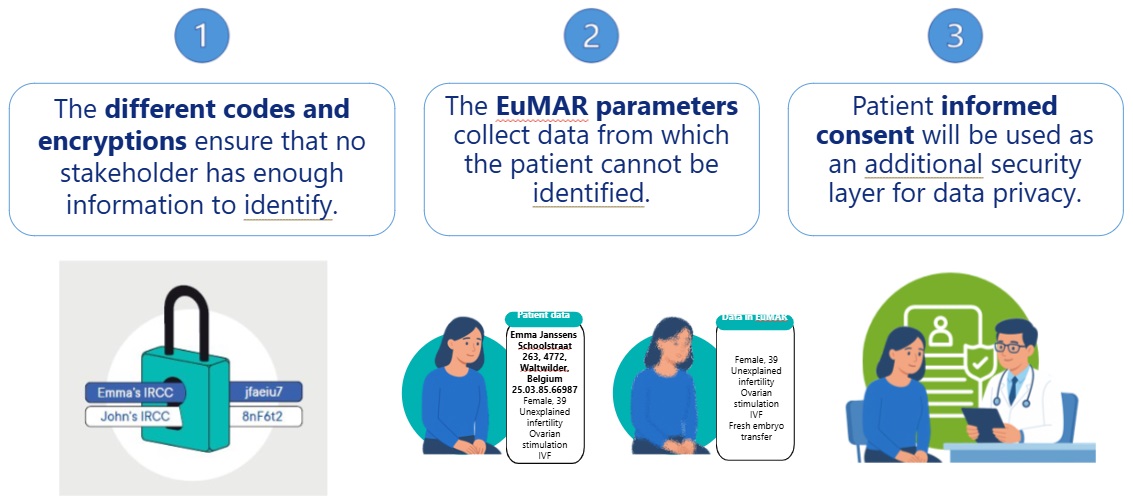
In addition, EuMAR enables the recording of data of cross‑border treatments, where patients receive care in different countries. This is an important and growing aspect of medically assisted reproduction in Europe, driven by differences in legislation, access, and availability of treatments. With the use of different patient codes, namely the Individual Reproductive Care Code (IRCC) and the Patient EuMAR Continuity Code (PECC), EuMAR can provide a more complete overview of treatments and outcomes that take place in different clinics across Europe.
Compared to traditional aggregated data:
- Cumulative data allows for more accurate time-to-live-birth estimations
- Cross‑border monitoring ensures that treatments performed in different countries are not lost or fragmented in national reporting systems
- Cycle-by-cycle, prospective data collection can support early detection of adverse reactions and events for the continuous improvement of medical care
- Enhanced data quality and comparability support evidence-based decision-making at both national and European levels
By moving beyond aggregated reporting, EuMAR contributes to a more accurate, transparent, and patient‑focused understanding of MAR treatments in Europe, strengthening patient safety, clinical practice, and health policy.
Data privacy in EuMAR